Thermal Camera Loft Insulation Survey Uk
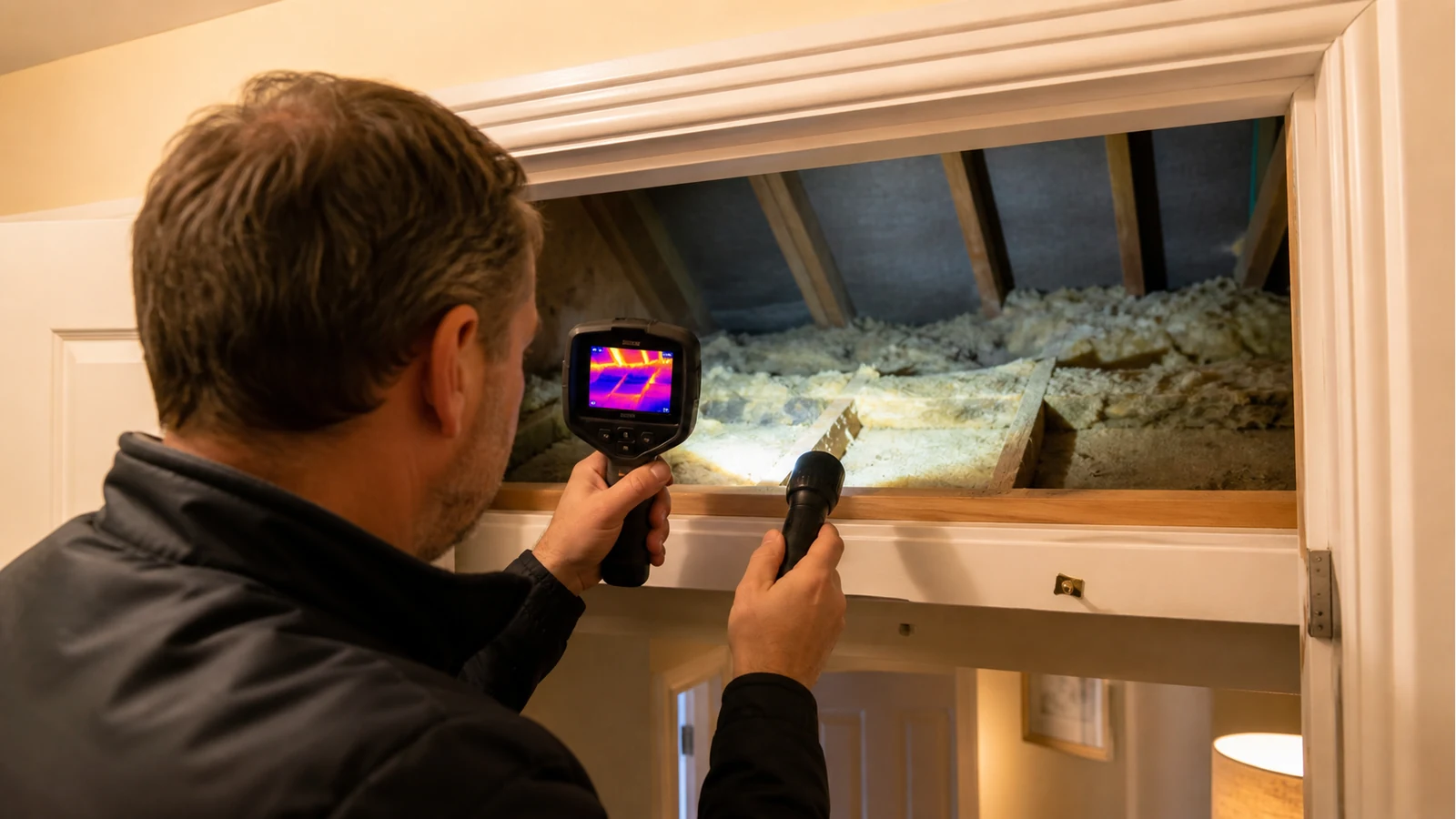
Direct answer: a thermal camera can help a UK surveyor run a first pass for loft insulation gaps by showing irregular cold or warm surface patterns under suitable conditions. It still needs visual loft confirmation, and it should not be used to sell precise energy-saving numbers from one scan.
Use the camera as a screening pass
RICS introduction to building thermography lists missing or incomplete insulation among building thermography uses, while warning against single-technique conclusions. That is the right frame for loft work: the image can point you to suspect areas, but the loft still needs safe access, a torch, and physical verification where possible.
First-pass checklist
- Choose stable cold weather or after-sunset conditions, avoiding solar-loaded roof and wall surfaces.
- Record heating status and any rooms that have been recently warmed or left cold.
- Scan ceilings below the loft, eaves edges, hatch surrounds and visible slopes in a repeatable order.
- Capture a visible reference or outline-rich image so the report reader can locate the area.
- Open the hatch only where safe, and do not step onto unsupported plasterboard or hidden services.
- Confirm suspected missing, displaced or compressed insulation visually before making a firm statement.
What can be stated
| Observation | Careful wording | Verification |
|---|---|---|
| Irregular ceiling pattern below loft | Consistent with uneven insulation or air movement | Visual loft inspection |
| Cold hatch outline | Possible draught or insulation weakness at hatch | Inspect seals and cover |
| Pattern affected by sun or recent heating | Unreliable for firm conclusion | Repeat under better conditions |
| Small isolated patch | May be service void, material change or damp clue | Check construction and moisture context |
Compact form factor matters because loft surveys are cramped. FLIR C5 product documentation documents the pocket inspection style of a compact C5-class device. Damp-survey explainers such as Sussex Damp Experts thermal imaging survey explainer also stress that cool patches need building context rather than a single-cause leap.
Negative fit
This is not the right basis for a one-scan promise about bill savings, a "see through insulation" claim, or unsafe loft access. The reader should proceed only if they can control conditions, keep the inspection safe, and verify what the thermal image suggests.