Thermal Imaging Before Lifting Floorboards Uk
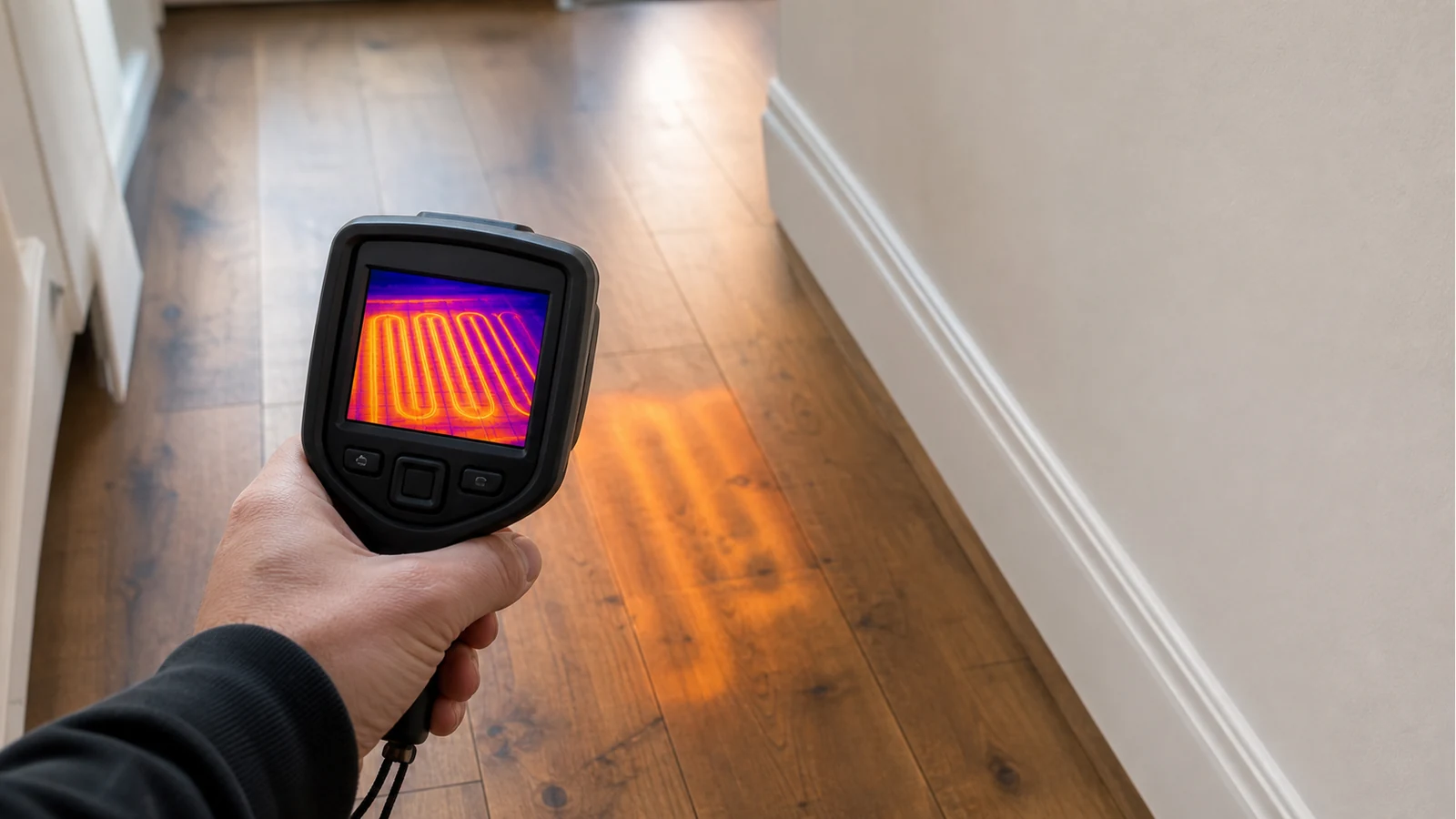
Direct answer: thermal imaging can help a UK plumber or heating engineer decide where to investigate before lifting floorboards, because it shows surface temperature patterns from warmed pipe runs and suspicious irregular zones. It does not X-ray timber, and it does not prove the exact leak point on its own.
Where it helps on a real underfloor job
The useful moment is not after half the floor is already open. It is when drawings are missing, the client can see a damp patch or one cold loop, and you need a defensible next step. UK leak-location firms describe thermal cameras as useful for mapping underfloor heating patterns and irregular warm areas; see Leak Detection London underfloor heating leak detection. Other UK services pair thermal imaging with pressure testing and tracer gas rather than treating it as a standalone verdict; see Complete Leak Detection underfloor heating service.
A practical sequence before opening boards
- Run the heating long enough to create a stable surface contrast. A cold system gives the camera little to work with.
- Scan the whole accessible floor, not just the visible stain. You are looking for the route, the normal loop pattern, and the odd patch that does not match it.
- Mark the floor physically with low-tack tape or a sketch. The image alone is less useful if nobody can transfer it to a board line.
- Use local checks next: spot readings, moisture meter, pressure test, acoustic listening or tracer gas depending on the symptoms.
- Lift only where the thermal clue and at least one confirmation method agree.
What the thermal image can and cannot say
| Finding | Reasonable interpretation | Do next |
|---|---|---|
| Clear repeated warm pipe pattern | Likely pipe route while the circuit is running | Use it for mapping and avoiding blind cuts |
| One irregular warm bloom | Possible wet spread, thinner covering, heat concentration or pipe feature | Confirm with pressure, acoustic or moisture checks |
| Weak or patchy contrast | Short run time, thick coverings or mixed finishes may be hiding the pattern | Change conditions or stop making camera-led claims |
| No visible anomaly | No useful thermal contrast at that moment | Do not promise there is no leak |
When a compact thermal camera is relevant
For recurring underfloor heating callouts, a pocket imager with visible-outline support and Wi-Fi filing can make evidence easier to show and store. FLIR C5 product documentation documents this kind of compact thermal workflow in the FLIR C5 category. If you already attend these jobs regularly, the relevant same-site product route is the compact thermal camera detail page; treat that as a tool-fit check, not a guarantee of leak coordinates.
Stop conditions
Stop relying on the image alone when the floor finish changes, the heating has not stabilised, the client needs an insurance-grade leak report, or the opening decision would be expensive. In those cases the camera is the first pass, not the final answer.